Pages

Showing posts with label historical fiction. Show all posts

Sep 30, 2013

September Genreflecting: Review: Code Name Verity by Elizabeth Wein

Genreflecting wordle

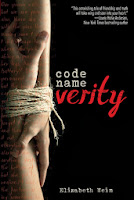
Code Name Verity cover
Oct. 11th, 1943-A British spy plane crashes in Nazi-occupied France. Its pilot and passenger are best friends. One of the girls has a chance at survival. The other has lost the game before it's barely begun.


When "Verity" is arrested by the Gestapo, she's sure she doesn't stand a chance. As a secret agent captured in enemy territory, she's living a spy's worst nightmare. Her Nazi interrogators give her a simple choice: reveal her mission or face a grisly execution.

As she intricately weaves her confession, Verity uncovers her past, how she became friends with the pilot Maddie, and why she left Maddie in the wrecked fuselage of their plane. On each new scrap of paper, Verity battles for her life, confronting her views on courage, failure and her desperate hope to make it home. But will trading her secrets be enough to save her from the enemy? 


From Goodreads


So this was a poor choice for this specific use. It's a PERFECT historical fiction representative, but I can't even begin to write a spoiler-free review at the moment because I'm still processing what just happened. Needless to say, I completely understand why this was one of the hottest books of 2012 & that summary above does the storyline justice. What it doesn't do justice for is Wein's writing. Her intricate writing style is impeccable & perfectly suited for this type of story. That's really all I feel I can say at the moment.

As for its historical fiction portrayal, this book was an exceptional example of what good historical fiction can accomplish. Maggie Stiefvater, a history buff who usually has trouble enjoying historical fiction books, adored this book. Check out her analytic & spoiler-free explanation on Goodreads.

While many people may not enjoy the wartime setting or the prisoner of war type books, Code Name Verity is so much more than that. It transcends pigeon-holing because it's not just about the time period or the events facing the characters; this book represents historical fiction's ability to appeal to all reader demographics because of it's meaning & presence. The story being told, about a true and meaningful friendship, is one that can exist in any time period. The uniqueness of this particular situation is what makes it so perfect for a historical fiction piece.

Not only is this book factual, it's also emotive. The locations & information are well-researched and the nationalities portrayed are quite accurate. What makes it work so well in this historical context is the ability to bring all these characters together & have them interact in their specific manners. I'm sure that's all a bit more muddled than I would prefer, but that's the best way I can think of to explain how unique this particular book is and why it was difficult to use as a historical fiction example.

I'll be cutting down my genreflecting posts to three a month due to my school & work load. I may combine the general & details posts or I may only review one book. My determination to finish this series is strong & I hope you'll bear with me during this transitional period.

Sep 20, 2013

September Genreflecting: Review: Lyddie by Katherine Paterson

Genreflecting wordle
Lyddie cover
When Lyddie and her younger brother are hired out as servants to help pay off their family farm's debts, Lyddie is determined to find a way to reunite her family once again. When Lyddie hears about the mill jobs in Lowell, Massachusetts, she heads there with the goal of earning enough money to reunite her family. 

Six days a week from dawn to dusk Lyddie and the other girls run weaving looms in the murky dust - and lint-filled factory. Lyddie learns to read - and to handle the menacing overseer. But when the working conditions begin to affect her friends' health, she has to make a choice. Will she speak up for better working conditions and risk her job - and her dream? Or will she stay quiet until it is perhaps too late?

From Goodreads

The industrial revolution in the United States was just as harsh on the population as in Europe. With constant in-fighting among all the companies & factory owners, the workers suffered heinously. Lyddie is no exception. 

When her father runs off in search of better fortunes for his family, leaving behind several young children [of which Lyddie is the eldest] and a mentally unstable wife, Lyddie steps in to manage the family's affairs. It's not long until her mother finally loses it and ships Lyddie and her younger brother off to work out the debts their father incurred while she prays for salvation with the two youngest children.

At first Lyddie dreams of returning to her family's farm & getting things back to the way they used to be. She holds on to the good memories she has while working her way towards a better future. Unfortunately the lights on her dreams are dimming with each bit of news she receives. Will she survive the tumultuous factory setting & thrive or will she just become another casualty in the war of progression?

Lyddie is an incredible read. While at times difficult to comprehend given the vernacular used, it still paints a realistic and accurate portrait of life in the industrializing era of United States history. Lyddie displays so much character & strength as she tries to do what's best for her family. What she sometimes forgets though is that she is still just a child herself and cannot solve every problem.

The setting & social issues represented in this book are spot on. From the Quaker family, to abolition, to hiring help, this book is an impeccable representation of a bygone time. While I do not wish to live it, the history that it represents is very important to the development of today's society. I find it incredibly fascinating that I can pinpoint to certain situations & scenarios that lead to particular events in history. This may be a small, rural area story, but that makes it even more vital to the history component. It shows that the situation was the same all over the place.

There wasn't a finalized resolution to the story & I think I prefer it that way because it allows me to dream up my own ending for Lyddie's life.

What are some of your favorite historical fiction books?

Sep 13, 2013

September Genreflecting: Historical Fiction: The Details

Genreflecting wordle

Based on the Collins English Dictionary, a subgenre is "a category that is a subdivision of a larger genre." (Source) Historical Fiction can be divided many different ways depending upon the reader's focus. There really is something for everyone in this genre.

Many people like to read books about specific time periods. Considering the length of man's written history, there are a multitude of options ranging from indigenous peoples in pre-colonization eras, the Industrial Revolution, the 1960s, & even wartime (which one, I'll let you decide). Each period has distinct characteristics that attract certain readers & allow them to more fully enjoy the plot. It can add a lot of texture and meaning to the story depending on the characters' actions in particular time periods.

Another way to divide this genre is by location. England in the 1850s would be completely different than the United States in the 1850s which would be even more different from the indigenous people of the Amazon Rain Forest during the 1850s. To quote The Doctor, "People assume that time is a strict progression of cause to effect, but *actually* from a non-linear, non-subjective viewpoint - it's more like a big ball of wibbly wobbly... time-y wimey... stuff." (IMDB) That's how I feel about how these events transpire. When we think of the timing of events, we tend to put things chronologically to organize them, even if they had/have no effect on one another. That's what I love about location-based historical fiction, it's like getting 2 books in one: another place and another time.

Ann Rinaldi has some great words about writing the fiction in historical fiction.

Where in your novels does the history end and the fiction begin?
" I will only invent in history when history doesn't provide information...only when I run into a brick wall in research." I include in my novels an Author's Note which clarifies verifiable fact from personal creation. I look at gaps in recorded history as a challenge and an opportunity to create character."

Have you ever received any backlash for your depiction of history?
"No. I recognize that there is a definite risk involved in creating a personality/childhood/feelings for a historical figure. However, one must take risks in life. I never contradict documented fact and always note what is my own invention."


Be sure to check back next Friday when I review Lyddie by Katherine Paterson.

Sep 9, 2013

September Genreflecting: Historical Fiction: The Basics

Genreflecting wordle

I wanted to do a reading challenge for the subject of Genreflecting, but I didn't get much feedback (maybe because it asked you to read 2 books for each genre and discuss them or because it's not really a "reading challenge" per se, but more an educational experiment), so I've turned it into a monthly feature! For each month of 2013, there will be a specific genre that will be analyzed. I'm planning to have author input and at least 2 reviews of books in the genre as well.

September's genre is Historical Fiction! These books, obviously, are set in the past and can vary from recent past (like the 1960s and 1970s) to several centuries ago (1700s). These kinds of books appeal to all manner of readers based on place, time period, & character backgrounds. It's a way to travel back in time to a personally unfamiliar (or favorite) era and experience someone else's life for a while. Equal parts entertaining & informative, these  books never cease to please a reader because of the amount of variety available. Some people prefer to read about certain eras or time periods, while others prefer certain places to be predominately featured. No matter what you're looking for, you're sure to find something to like. (adapted from the Teen Genreflecting, 2nd edition)

I enjoy a wide variety of historical fiction books ranging from:
I'm excited to say that I've chosen my two books, one older and one newer, to read for this challenge. The older book is Lyddie by Katherine Paterson (originally published in 1991) and I'll have a review and analysis up on Friday, September 20th. The newer book is Code Name Verity by Elizabeth Wein (originally published in 2012 [in the US]) and I'll have a review and analysis up on Friday, September 27th. I'll also be hosting a giveaway, so stay tuned!

Aug 30, 2013

August Genreflecting: Review: Secret Keeper by Mitali Perkins

Genreflecting wordle

Secret Keeper coverWhen her father loses his job and leaves India to look for work in America, Asha Gupta, her older sister, Reet, and their mother must wait with Baba’s brother and his family, as well as their grandmother, in Calcutta. Uncle is welcoming, but in a country steeped in tradition, the three women must abide by his decisions. Asha knows this is temporary—just until Baba sends for them. But with scant savings and time passing, the tension builds: Ma, prone to spells of sadness, finds it hard to submit to her mother- and sister-in-law; Reet’s beauty attracts unwanted marriage proposals; and Asha's promise to take care of Ma and Reet leads to impulsive behavior. 
What follows is a firestorm of rebuke—and secrets revealed! Asha’s only solace is her rooftop hideaway, where she pours her heart out in her diary, and where she begins a clandestine friendship with Jay Sen, the boy next door. Asha can hardly believe that she, and not Reet, is the object of Jay’s attention. Then news arrives about Baba . . . and Asha must make a choice that will change their lives forever.

From Goodreads

Secret Keeper was unlike any other book I've read. Set in the tumultuous times of 1970's India, we follow the story Asha, her older sister Reet, and their mother as they adjust to life with their in-laws and without their father. Suffocating under the oppressive and strict rule of her Uncle, Aunt, & Grandmother, Asha escapes into her journal writing on the roof and by pushing boundaries. Not comfortable with giving up her liberty, Asha clings to the hope that the day that her father sends for his family will come soon.

Things don't go nearly as smoothly and Asha's patience begins to run out. With options dwindling by the day, she chooses to take matters into her own hands as much as possible. In a setting where her opinion is of little to no value and her place is decided for her, will she ever learn to fit in or will she have to fight for every little thing her father always wanted for her and their family?

I was completely blown away by this book! Every time I thought I knew what was going to happen next, I found myself shocked by what actually happened. It was in those moments that I realized that I had been conditioned to expect certain events to occur in my books. Which if they were set in modern day (or even historical) America, I might have been right. The cultural differences really made this book stand out to me. While some might write off Asha as weak or submissive, I think her actions in this book show great courage when viewed in context. 

There was so much more going on under the surface of this book. It was as if every action or event had a double meaning, the meaning for the story and the meaning for society. I think it was beautifully written with just enough contextual clues to give the reader an overview of the historical and cultural importance of events transpiring without bogging down the storyline. 

Most importantly, I think this book is a gateway book. I was so engrossed in it that it made me want to read more books like it. These can be the best way to meet new cultures and experience life in someone else's shoes. This book did an incredible job showcasing how teenagers in all societies are really the same because they struggle with themselves and their place no matter what situation they are in. I think I prefer this kind of book that follows someone within their own culture because I think it presents a more multi-dimensional presentation of the society without focusing on the differences between groups.

I hope you'll all take this long weekend (for those of us in the US celebrating Labor Day on Monday) to expand your reading horizons if you haven't done so recently. It's really worthwhile.

Jun 21, 2013

June Genreflecting: Review: Briar Rose by Jane Yolen

Genreflecting wordle
Briar Rose coverEver since she was a child, Rebecca has been enchanted by her grandmother Gemma's stories about Briar Rose. But a promise Rebecca makes to her dying grandmother will lead her on a remarkable journey to uncover the truth of Gemma's astonishing claim: I am Briar Rose. A journey that will lead her to unspeakable brutality and horror. But also to redemption and hope.

From Goodreads

What grandmother doesn't tell fairy tales to her grandchildren? Gemma is a natural storyteller, but she only ever tells the same story, the exact same way every time. Briar Rose, or as most people know her Sleeping Beauty, is a familiar tale about love, loss, and rallying your strength after the loss. For Rebecca's whole life she's heard Gemma tell the tale. She's heard it so much that she even knows it by heart, including the part where Gemma swears she is the girl in the tale. Rebecca makes the promise to discover the truth behind the story to her dying grandmother. The adventure that ensues is one that no one could have foreseen.

Told in alternating chapters of present day situations and Gemma's version of the fairy tale, Briar Rose is sorrowful, but important book about survivors. Being the descendants of Polish Jews, you can't expect that everyone made it out of the Holocaust alive, but the truth is even more shocking than that. Since we don't know the grandmother's version of the fairy tale from the beginning, we learn it as we move through the story so that we can piece the whole puzzle together.

Expertly researching and written, this book is a testament to Holocaust fiction. It was a unique twist on an otherwise dark story. That's not to say there aren't some dark portions to the tale, but it was considerably less than I was expecting with something of this nature. What really drew me in was the hidden truth. There are so many clues and so many directions they point in that even the characters are overwhelmed, but they are fairly easily navigated & accounted for until the complete truth is clear. 

As for the fantasy element, this was no where near a normal fantasy. It falls under the fairy tale retelling section, but just barely. The whole premise is based around the Briar Rose story and while true life does mirror the fairy tale, it takes until the end of the story for us to really see that. Normally in retellings you get the sense of deja vu or something that automatically reminds you of the original tale. That being said, it still counts and is a special version of a retelling. You can't go into it thinking you're going to get a regular story, but what you get is so much more.

Be sure to come back next Friday when I review Bitterblue by Kristin Cashore and host a giveaway!

Feb 8, 2013

February Genreflecting: Romance: The Details

Genreflecting wordle

Based on the Collins English Dictionary, a subgenre is "a category that is a subdivision of a larger genre." (Source) Romance is a complicated and yet fundamental part of the young adult experience. There are so many changes going on during that time in a young person's life, so naturally we have a whole genre dedicated to it! Primarily, romance books tend to fall into one of these subgenres: contemporary, chick lit, historical & serial. While the others are self-explanatory, that last one actually covers two types of serial romances: the first type follows one character's love life while the other one follows a different individual from a specific group during each book.

One of my absolute favorite contemporary romances is Nick & Norah's Infinite Playlist by David Leviathan & Rachel Cohn. These two created an incredible book that volleys between its two protagonists to tell the story. Here's a snippet about how this awesome book came to be:

One day David and I were having lunch together and I mentioned that I had a vague idea for a book: I wanted to write about two New Jersey, straight-edge characters named Nick and Norah (after the Thin Man movies) who would meet at a music club in Manhattan. I wanted to follow their adventures throughout the one night, and just see what would happen. ... We didn’t plan any of the book out in advance, we just picked up each chapter where the other left off, and I think the fun David and I found in writing to challenge one another translated into a true adventure for Nick and Norah – just like a real first date, where there can be great chemistry, but you really have no idea if it will turn out well or not. You can only dive in and hope. -Rachel Cohn's website

And while I'm not an outright fan of romances, almost anything set in a historical time wins my vote. That's why Anna Godbersen's The Luxe series was so perfect for me. In an interview on Galleysmith she explained why she liked writing historical books:

When I was a bookish teen, I loved novels set in other times, other realities, other universes. So that’s part of it—being able to create this world that looks and smells and sounds different than the one my readers and I walk around in every day. I want to transport them, and myself. And then, once you’re there, the historical setting means that the realities of life, the situations my characters are going to find themselves in, will often be ones you couldn't have in a contemporary setting, which is exciting stuff for a writer! Very plot-friendly.

So there you have it. A little insight into the world of romance books. What are your favorite types of romance? Do you enjoy a heart-wrenching roller coaster or a more subdued novel? Be sure to check back next week when I review Forever by Judy Blume. 

Jul 18, 2012

Waiting on Wednesday: The Lucky Ones (Bright Young Things #3) by Anna Godbersen

Waiting on Wednesday recognizes that we as bookies pine for books. This post is about what I am impatiently waiting for right now. It was started by Jill at Breaking the Spine.

This week I am really excited about the third installment in Anna Godbersen's Bright Young Things series. You may remember that I really loved her Luxe series & this one is no different. And while I haven't had a chance to read the 2nd book in this current series (Beautiful Days) it has been on my TBR pile for a bit. That being said, I think I'm coming up on a historical fiction mood, so this may get bumped up. As a result I'm revealing what little information there is for The Lucky Ones due out September 18th.

The Lucky Ones coverLetty's rising star is threatened by a new rival...

Astrid's relationship with Charlie takes a dark turn...

And Cordelia vows revenge against the Hales - once and for all...


From Goodreads


While that's not much to go on, considering what little I know from the first book & the summary of the second, this is going to be one doozy of an installment. Have you read these? What do you think? Do you prefer one series over the other. And, as always, what are you waiting on this week?  

Apr 3, 2012

Anxious Hearts by Tucker Shaw review

Anxious Hearts cover“Evangeline,” he repeated, calling at a whisper. “Evangeline.” He was not calling that she may hear, he was calling that somehow her soul might know that he was devoted entirely to her, only to her. “Evangeline, I will find you.”

Eva and Gabe explore the golden forest of their seaside Maine town, unknowingly tracing the footsteps of two teens, Evangeline and Gabriel, who once lived in the idyllic wooded village of Acadia more than one hundred years ago. On the day that Evangeline and Gabriel were be wed, their village was attacked and the two were separated. And now in the present, Gabe has mysteriously disappeared from Eva.

A dreamlike, loose retelling of Henry Wadsworth Longfellow’s famous love poem “Evangeline,” Anxious Hearts tells an epic tale of unrequited love and the hope that true love can be reunited.


From Goodreads

This book is so much more than that description can convey. I must admit that I blindly stumbled into this one & I kind of wish I had done my homework. In a way I wish I had read Longfellow's poem before reading this book & in a way I'm glad I didn't. By not reading the poem I was able to appreciate the book for what it was & how it was created. Tucker Shaw has done a masterful job weaving the two tales of his lovers
(both past & present) in a way that is both believable & visceral. Mesmerized by the poetry of this book (which isn't written in poetic format) I flew through it in a few short hours & was ready to devour it again once I had completed the first reading.

While I think reading the original work may have helped me better understand the overall experience of the book, I found experiencing the author's interpretation just as satisfying. Eva & Gabe (our present day lovers) aren't your average teens. They've seen heartache & misery that has touched them deeply. Only they can truly understand the others' pain to the point that they run together away from those who would pity them. Evangeline & Gabriel are the epitome of love. Their joy was ready to reach heights that no one around them had witnessed when they were dealt the blow of being torn apart. Their separation & struggle to return to one another is what overlaps their story with that of the present day. Both couples are fighting a losing battle with no care for the outcome, only the solace they seek to bring to themselves & their lover.

Such a deep, moving book Anxious Hearts is not one to be missed. You won't regret living this love story with characters you will hate to see go.

Mar 9, 2012

Ten Cents a Dance by Christine Fletcher review

Ten Cents a Dance coverWith her mother ill, it’s up to fifteen-year-old Ruby Jacinski to support her family. But in the 1940s, the only opportunities open to a Polish-American girl from Chicago’s poor Yards is a job in one of the meat packing plants. Through a chance meeting with a local tough, Ruby lands a job as a taxi dancer and soon becomes an expert in the art of “fishing”: working her patrons for meals, cash, clothes, even jewelry. Drawn ever deeper into the world of dance halls, jazz, and the mob, Ruby gradually realizes that the only one who can save her is herself. A mesmerizing look into a little known world and era.

From Goodreads

Ruby Jacinski is a good daughter. She has always done whatever was necessary to take care of her family. With a deceased father & a mother riddled with rheumatoid arthritis, Ruby drops out of school & goes to work in the meat packing plant. Even with all her hard work, it's just not enough. The basic ends aren't really being met & Ruby is at a loss as to what to do.

Enter Paulie, a rather smarmy young gent, who introduces Ruby to the idea of teaching the latest dances to willing-and-able-to-pay men. While she's a bit stricken by the idea of dancing with strange men for money, she does love a good beat & soon enough she's working at a taxi-dance hall. Earning it's name because the men are renting girls a dance at a time, Ruby soon finds herself out of her league in regards to customers' expectations & some stiff competition. Never one to give up, especially with everything at stake, Ruby begins to navigate the tricky waters of hiding her profession from her family & still being flashy enough to catch the big paying customers. Her balancing act is precarious at best & sooner or later, something's got to give.

Such a fascinating time period! This book instantly caught my eye because it's an era that not many people write about. Prohibition is big for the 20's & the hippies are good for the 60's, but the 40's seem to get lost in teen literature unless it's about the war. Well this book turns that notion on it's head by setting us up in the hip & swinging Chicago night life. We learn about all sorts of historical settings like the boom of jazz music, the struggle of the lower-class immigrant families & the illicit scenes that pervade the seedier parts of major cities.

Ruby moves through all these worlds with the biggest of eyes allowing the reader to really gain a sense of what it was like to live it. Such a passionately vibrant character in such muddled times helps the reader understand the reality of day to day struggles for a young woman. Even more characteristic of the time period is the trusting nature & gender roles that everyone subscribes to throughout all the sub-societies.

The story-telling is masterful with rich details that I can only presume come from either extensive research or first-hand tellings. This radically different world, in much simpler times, is a nice reprieve from the hustle & bustle that is our day to day existence. There really wasn't anything about this book that turned me off. The characters were unique & the story was one that I will never forget. A fast read, with deeper sentiments, it's no wonder that Ten Cents a Dance made ALA's Top Ten Teen Reads in 2009. I will worn those who might forget (or even be unaware) but as this is set in the 1940's, segregation is still a big thing & mixing races (for any purpose) is taboo, so there are some sensitive word choices (obviously made for authenticity). Nothing that you wouldn't read in Mark Twain, but enough to get the point across.

Fans of this might want to also try these historical fictions: The Luxe, Bright Young Things, Flygirl or The Vespertine. (All links go to my reviews). Anyone else read this one? What else would you suggest?

Sep 21, 2011

Waiting on Wednesday: Darker Still (Magic Most Foul) by Leanna Renee Hieber

Waiting on Wednesday recognizes that we as bookies pine for books. This post is about what I am impatiently waiting for right now. It was started by Jill at Breaking the Spine.

So you may not know this, but I'm a decent sized fan of classical literature. I enjoy the writing quality, the terminology & the scandals so much better! Darker Still (Magic Most Foul #1) by Leanna Renee Hieber is perfect because it seems to blend all these things together. Due for release on November 1 from Sourcefire Books, this is sure to be a crowd-pleaser.

The Picture of Dorian Gray meets Pride and Prejudice, with a dash of Dr. Jekyll and Mr. Hyde.

New York City, 1882. Seventeen-year-old Natalie Stewart's latest obsession is a painting of the handsome British Lord Denbury. Something in his striking blue eyes calls to her. As his incredibly life-like gaze seems to follow her, Natalie gets the uneasy feeling that details of the painting keep changing...

Jonathan Denbury's soul is trapped in the gilded painting by dark magic while his possessed body commits unspeakable crimes in the city slums. He must lure Natalie into the painting, for only together can they reverse the curse and free his damaged soul.

From Goodreads

How mesmerizing does that sound? It really is all those classics rolled up into one! Provided the author keeps the mystery going & depicts the time period with accuracy & reverence, this could shape up to be one of the best historical fiction books since The Vespertine. What are you waiting on this week?

Apr 4, 2011

Purple Daze by Sherry Shahan

Purple Daze coverI'm using the Goodreads blurb because my summary gave away too much & I really wanted to leave the content as a surprise. The way the novel unfolds is much more eloquent & enrapturing than any summary I could devise.

Purple Daze is a young adult novel set in suburban Los Angeles in 1965. Six high school students share their experiences and feelings in interconnected free verse and traditional poems about war, feminism, riots, love, racism, rock 'n' roll, high school, and friendship.

Although there have been verse novels published recently, none explore the changing and volatile 1960's in America— a time when young people drove a cultural and political revolution. With themes like the costs and casualties of war, the consequences of sex, and the complex relationships between teens, their peers, and their parents, this story is still as relevant today as it was 45 years ago.

From Goodreads

This book blew me away! I thought that I had read all the different versions of 1960's youth portrayals & that this would fall under the category of "been there, done that, got the t-shirt." I'll be the first to admit, I was way wrong.

We are introduced to the six main characters who are all loosely related to one another & who all represent different movements (for lack of a better word) from this time period. We have feminism, drug use, anti-war protesting, draftees serving in Vietnam & a whole slew of other things. These teens are at the most pivotal points in their lives where they are branching out of the "safety" of their parental homes & really discovering who they are & what they are willing to fight for in their lives.

The 1960s was a turbulent era because the youth were going in divergent directions. Specifically, this book takes place in 1965 (after the assassination of JFK) & so these teens we're following have experienced a great trauma & are insecure in regards to the future. Not only are they experiencing social & political upheaval, but even the music is "dangerous." Bob Dylan, The Beatles, Jimi Hendrix... just to name a few. Watching these teens choose their own paths based on their personal experiences was mesmerizing. And never fear if you aren't a history buff, there is more than enough context clues & subtle hints to help you understand what's going on.

Simply put, this book is profound. It will challenge what you think you know about an adolescence during this time & help you to understand why it is such a pivotal time in this nation's history. A tremendous read, I can't wait to buy a finished copy. I leave you with a song dripping with history.


ARC kindly provided by the author.

Feb 24, 2011

Victorian New England

Good day ladies & gentlemen! I am very pleased to bring you some background information on the lovely setting of The Vespertine. I will be focusing on Victorian society in general & also commenting on Victorian society specifically in New England.

A young lady could aspire to no higher station than that of a dutiful wife & engaging mother. These ladies were expected to be well-bred, mild-mannered, capable in matters of the home, involved in charitable pursuits & virtuous. Women of stature were not to work outside of the home, but some of the middle class women would work as seamstresses or laundresses to made ends meet at home. As Lynn Abram reports, "...the ideal woman at this time was not the weak, passive creature of romantic fiction. Rather she was a busy, able and upright figure who drew strength from her moral superiority and whose virtue was manifested in the service of others."

At home, women were expected to maintain a tightly run household. Many affluent families filled their time with social dates, well-prepared meals (either made with their assistance or by the help), neatly groomed children & charity work. Maintaining a home was a full-time job in and of itself, so many women could still find themselves over-loaded with tasks. It's interesting to note that, "It is a fallacy that most middle-class women were able to afford sufficient servants to allow them to spend their lives in idle leisure. Most middle-class households had just one servant - sufficient to give the woman of the house a certain status, but insufficient to allow her to spend days doing embroidery and playing the piano."

Women were not "confined" to the home as many of us mistakenly think, they were actually quite active in the community. While "motherhood was idealized as the zenith of a woman's emotional and spiritual fulfillment," many women spend time visiting, not only with friends, but also with the less fortunate, volunteering with different organizations, & spending time with their church. One of the more fascinating parts of this custom was the need for calling cards. If you were to "call on" (go visit) someone, it was expected that you have a calling card to announce your intent. Your admittance would be conditional based upon your station & card.

In The Vespertine we watch the main characters emulate many of these specific patterns of behavior. Zora, Amelia, Sarah & Mattie all spend time practicing their etiquette at teas & balls, while expending their energy in the park with archery. I personally loved the scene where Zora & Amelia are choosing new calling card patterns & all the rules you hear in the shop. Thomas & Nathaniel are very representative of two very different societal classes with Thomas apprenticing his father in the medical field & Nathaniel making do on his own through art & sporadic side work. Zora's mother, Mrs. Stewart is seen working on embroidery & assisting her cooks to make her household run smoothly.

Baltimore was a fabulous setting for this book! As there is a harbor, this town was poised for change. While the Victorian age was rather strict & regimented, as the era came to a close and industry started to really grow, Baltimore would be one of the first places affected since it was a major port. New ideas, fashion, & people came through this area allowing for change & influence to transform the area. Mr. Stewart (Zora's father) was an impetus to this change as he wanted gas lighting in his home & his daughter to receive a co-educational experience! Quite a happening time period!

I hope you have enjoyed learning a little history about this setting & I hope it gives you a deeper appreciation for the novel. Don't forget to check back tomorrow for more happenings during The Vespertine week here at Tattooed Books!

Jan 13, 2011

The Vespertine by Saundra Mitchell

All Amelia van den Broek wanted was to enjoy her one free summer in Baltimore with her cousin Zora. The summer of 1889 started out like it was going to be the best time of her life! Amelia was in society, attending balls, meeting hoards of eligible men & having fancy calling cards made to drop off when she went calling on her new friends. All of this was preparation for her to find a suitable man to marry. Too bad she fell in love instead.

Nathaniel Witherspoon was nothing like anyone Amelia had ever met. An artist, Nathaniel made his way in life however he could & did as he pleased. Inspired by that life, Amelia & Zora did the same. When they discover that Amelia has a talent for seeing other people's futures in the sunset, the girls decide to allow certain people the joy of discovering their futures. As the summer moves forward though, Amelia finds herself falling harder for Nathaniel & risking, not only her reputation, but her life. When Amelia begins to see that not all her fortunes are happy, she becomes frightened of her powers & what it could mean for all of them.

Fan-FREAKING-tastic is how I would describe this amazing novel! The action, the drama, the impropriety & the romance are all so breath-taking. I thoroughly enjoyed every part of this book.

The speech & mannerisms were dead-on for the time period & I was thrilled to have another paranormal/mystical historical fiction novel to devour. The Victorian-era rules of society are ones that have fascinated me for years & I found this book's presentation of those rules to be quite appropriate. I really felt like I was there & I was experiencing these admonitions & allowances with Amelia.

The characters were some of the most intriguing people I have encountered in such a novel. While the societal interactions had touches of the "country mouse visiting the city mouse" basics, I felt that there was still a deeper conflict between the characters. Standing & reputation meant a lot to these people & society during this time & so for Amelia to come in from the country & take up residence in their circles was just unheard of if she didn't use appropriate comportment. Zora was by far one of my favorite characters. Her vivacious nature & tenacity really lent a sporadic nature to the female characters.

Overall I must say that this is shaping up to be one of my favorite books of 2011. Be sure to keep your eyes out for this book & don't let it pass you by. There is enough intrigue, romance & history to please almost any reader!

Dec 3, 2010

Nostalgic Friday: Holocaust Books

Welcome back to Nostalgic Friday! Since I love all things historical (culturally, physically, and personally) I do a post on Fridays honoring some awesome book that is a bit older. Many of them are books I enjoyed in my teens and others are books that I discovered as an adult that I think are relevant to YA readers.

I know that everybody has to read at least one book about the Holocaust during their middle grade or high school years, but I apparently got a few more assignments than most. Between 5th & 8th grade I read at least 4 books for school and at least two dozen more on my own. My Holocaust education didn't stop there & probably never will, but I thought I'd share with you some of my preferred books. There's a smattering of fiction & non-fiction in here, but hopefully you'll find something that piques your interest.

Number the Stars by Lois Lowry Fiction
Ten-year-old Annemarie Johansen and her best friend Ellen Rosen often think of life before the war. It's now 1943 and their life in Copenhagen is filled with school, food shortages, and the Nazi soldiers marching through town. When the Jews of Denmark are "relocated". Ellen moves in with the Johansens and pretends to be one of the family. Soon Annemarie is asked to go on a dangerous mission to save Ellen's life.


The Devil's Arithmetic by Jane Yolen Fiction
Hannah thinks tonight's Passover Seder will be the same as always. Little does she know that this year she will be mysteriously transported into the past where only she knows the horrors that await.

Night by Elie Wiesel Non-fiction, Memoir
In Nobel laureate Elie Wiesel's memoir Night, a scholarly, Orthodox teenager is wracked with guilt at having survived the horror of the Holocaust & the genocidal campaign that consumed his family. His memories of the nightmare worlds of Auschwitz-Birkenau & Buchenwald present him with an intolerable question: how can the god he once so fervently believed in have allowed these monstrous events to occur? There are no easy answers in this harrowing book, which probes life's essential riddles with the lucid anguish only great literature achieves. It marks the crucial first step in Wiesel's lifelong project to bear witness for those who died.

Alicia by Alicia Appleman-Jurman Non-fiction, Memoir (a bit graphic at times)
After losing her entire family to the Nazis at age 13, Alicia Appleman-Jurman went on to save the lives of thousands of Jews, offering them her own courage and hope in a time of upheaval and tragedy. Not since The Diary of Anne Frank has a young voice so vividly expressed the capacity for humanity and heroism in the face of Nazi brutality.

There are also numerous websites & organizations that can be viewed in order to flesh out your knowledge.

Unites States Holocaust Memorial Museum http://www.ushmm.org/
The Holocaust History Project http://www.holocaust-history.org/
Holocaust Survivors http://www.holocaustsurvivors.org/
Holocaust section of the Jewish Virtual Library http://www.jewishvirtuallibrary.org/jsource/holo.html

There are thousands more, but these are my preferred sources of information. I chose this subject because it is something I don't think it taught well enough in our schools. This dark period is a lot more complicated that "the Germans killed 6 million Jews during WWII" & I think some of these books really shed some light on that. A quote I strive to live by every day is:
Those that fail to learn from history, are doomed to repeat it. - Winston Churchill

Nov 10, 2010

Waiting on Wednesday: Threads and Flames

Waiting on Wednesday recognizes that we as bookies pine for books. This post is about what I am impatiently waiting for right now. It was started by Jill at Breaking the Spine.

Threads and Flames by Esther M. Friesner on November 25th. We all know I'm a pretty big sucker for historical fiction & this one covers a little-discussed topic. As time passes we seem to forget the impact that many major historical events had on the people of that time period & how it influenced today's world. This book reminds us about one such event.

It's 1910, and thirteen-year-old Raisa has just traveled alone from a small Polish shtetl all the way to New York City. It's overwhelming, awe-inspiring, and even dangerous, especially when she discovers that her sister has disappeared and she must now fend for herself. She finds work in the Triangle Shirtwaist Factory sewing bodices on the popular shirtwaists. Raisa makes friends and even--dare she admit it?--falls in love. But then 1911 dawns, and one March day a spark ignites in the factory. One of the city's most harrowing tragedies unfolds, and Raisa's life is forever changed. . . .

One hundred years after the Triangle Shirtwaist Factory Fire, this moving young adult novel gives life to the tragedy and hope of this transformative event in American history.

From Amazon

How amazing does that sound? I could just devour this book right now! I'm glad it's only a few short weeks away and I'm really hoping that this book succeeds. Spread the word! What are you waiting on this week?

Oct 1, 2010

Nostalgic Friday: The Whipping Boy

Welcome back to Nostalgic Friday! Since I love all things historical (culturally, physically, and personally) I do a post on Fridays honoring some awesome book that is a bit older. Many of them are books I enjoyed in my teens and others are books that I discovered as an adult that I think are relevant to YA readers.

I have uncovered a book that I had completely forgotten about! The Whipping Boy by Sid Fleischman was originally published in 1986. This is a fabulous book for both guys and gals that involves adventure, fairness, and even a prince.

Jemmy is the Whipping Boy for Prince Horace. Whenever the Prince does something naughty, Jemmy is the one who must take the punishment for the Prince's actions. Tired of being beaten repeatedly for things he didn't do, Jemmy has decided to run away. With the basic education he has obtained while living in the castle, he's determined to set off for a new life with the freedoms he once enjoyed.

Unfortunately,the Prince has the same idea. Dragging Jemmy along as his servant, the Prince and Jemmy set off. It is not long before they are intercepted by dangerous highway criminals Hold-Your-Nose Billy & Cutwater. The highwaymen want to ransom the Prince back to the castle. Seeing an opportunity for escape, Jemmy claims that he is the Prince. After a clever trick, the boys are free again and continue on their journey.

Of course their freedom only lasts until the highwaymen catch up with them again. Still believing Jemmy to be the Prince, and knowing it to be a crime to harm him, they determine Horace to be the Whipping Boy and beat him instead. Beginning to understand the reality of Jemmy's existence, Horace's character shifts. Soon he is working with Jemmy to get them back to the castle to have the whole situation sorted out. But there are people out there who want the reward that has been posted and the boys must find a way to make it back without being captured again.

This is a fun, educational story. You don't really know that you're learning a moral lesson until you get to the end and put all the pieces together. Jemmy is a wonderful character with such values and standards that one has a tough time reconciling him with the awful child that is Horace. Obviously in this story, money and breeding do not necessary make the most conscientious minded people. The dichotomy between these two boys was staggering and it really helped put the moral in perspective.

The setting really allowed the story to flow easily and the plot moved quickly. This short novel packs a lot of action, intrigue, and fun into just 112 pages. A must-read for all ages, The Whipping Boy is simply fabulous!

Jul 22, 2010

The Education of Bet by Lauren Baratz-Logsted

Elizabeth "Bet" Smith has always been a lowly maid's daughter. She has known her station her whole life, but it has never prevented her from wishing for more. Living a comfortable life between family & servant in Grangefield Hall with Will Gardener & his Uncle, Bet has truly wanted for nothing; other than the education that Will doesn't desire.

After hearing of Will's dreams of military service, Bet hatches a fantastic plan. What if Will goes off to the military & Bet takes his place at the new school? As preposterous as it sounds, Bet manages to fool Will's Uncle and so Will goes along with the plan.

After splitting up at an inn, Bet continues on her way to Betterman Academy. School it turns out is nothing like Bet could have imagined. She has a roommate (the impropriety!!), the boys are raucous & cruel, and there are dances. Even harder to deal with than these things are the growing feelings Bet has for her roommate. What's a girl-disguised-as-a-boy to do?

I was pleasantly surprised by this book. While I could figure out the base storyline at the beginning of the book, I still enjoyed watching this particular version unfold. Bet was such a colorful and articulate character that I truly enjoyed watching her struggle to understand the behavior of those around her and the decisions she had to make regarding her own reactions. Will, while mostly absent from the main storyline, was quite entertaining as well. He was that rogue boy every girl dreams of during this time period. There was a little mystery to him, but really he just wanted to be himself.

The interactions of the characters were what made this book such a success! I could not imagine this book being pulled off nearly as well if the characters had been flat and unengaged. They all had their roles to play from the dashing rogue, to the bully, to the stern, silent type. Everyone dealt with each other in such a particular fashion that, even if the subject wasn't identified, you knew who was speaking or doing the action. That is a rare quality in a book that I truly enjoy & admire the author's ability to pull it off.

A wonderfully charming read, The Education of Bet is one that I feel deserves at least one read. Take a peek. I promise it'll be worth it.

My many thanks to Around the World Tours for loaning me this book.

Jun 18, 2010

Nostalgic Friday: Memoirs of a Geisha

Welcome back to Nostalgic Friday! Since I love all things historical (culturally, physically, and personally) I do a post on Fridays honoring some awesome book that is a bit older. Many of them are books I enjoyed in my teens and others are books that I discovered as an adult that I think are relevant to YA readers.

I can't believe I didn't think to cover this book earlier, but Memoirs of a Geisha by Arthur Golden trulyMemoirs of a Geisha is a magnificent work of real-life meeting fiction. This was not a novel written with just a few years research and a lot of conjecture, Golden was fascinated by the Japanese people so much that his B.A. in Art History focused on Japanese art and one of his M.A.s is in Japanese history. The whole novel took him 10 years to write while he interviewed many geisha, including the famous Mineko Iwasaki, and studied the art form. The result was this:

Chiyo Sakamoto is one of two daughters sold into servitude by a poor fisherman in the hopes of raising enough money to save his dying wife in 1929 rural Japan. At first the sisters are kept together, but eventually they are sold into separate okiyas (geisha houses). Chiyo is working off her purchase cost, but continues to add debt to her bill when she tries to please the lead geisha Hatsumomo (by destroying a rival's expensive kimono) and when she is severely injured while trying to run away.

After a chance meeting with Chairman Iwamura Ken, Chiyo decides that she no longer wants to live in fear of never surmounting her debt: she wants to be a beautiful geisha. Chiyo gets to continue her geisha training with one of the most powerful geisha, Mameha, and takes her apprentice geisha name of Sayuri. At her debut, a bidding war begins for her mizuage (virginity), fetching the highest price in memory and buying off her debt. The okiya that Sayuri has slaved in for years is now here's when the current owner dies.

As the years progress, there are tensions that come and go with the pressure of geisha life. There are parties to attend, ceremonies to observe, rival geisha to avoid, & a distinct lack of romantic love. When World War II breaks out, everyone's lives are irrevocably changed. Some for the better and some not.

This was an incredible story based in years of research, observation, and interviews. It's plausible that this story could have happened. Arthur Golden's writing style is evocative of the beauty that exists in this society & cultural. Many people see geisha as trapped women with no personalities; Arthur explores the reality of what it would have been like to be raised in a culture that admires the hard work and dedication these women possess in order to manipulate their clientele. The clients weren't paying for sex, they were paying for the experience of an entertaining force.

Of all the geisha mentioned in the book, I think my favorite has got to be Mameha. She is a tough geisha with a kind heart. I would compare her to a high-powered female attorney, she knows her stuff and knows how to make people work in her benefit. Chiyo/Sayuri is an amazing person as well considering we watch her grow from scrawny, adolescent child into a strong, powerful woman. She never really seems to boast about her accomplishments and really only wants to live a simple life, but she has a grace about her that can only come from within.

The language in this book is another thing that drew me to it. I really enjoy a book that properly uses words in another language in a contextually appropriate way. Frivolously throwing out words is useless. All the language used in this book had purpose and meaning. Truly amazing! While it can seem cumbersome, once I got lost in the story, I tore right through the whole book. The 2005 movie adaption really captured the visual side of the story. Check it out if you've never seen it, but only after you read the book! :)

Jun 11, 2010

Nostalgic Friday: The Other Boleyn Girl

Welcome back to Nostalgic Friday! Since I love all things historical (culturally, physically, and personally) I do a post on Fridays honoring some awesome book that is a bit older. Many of them are books I enjoyed in my teens and others are books that I discovered as an adult that I think are relevant to YA readers.

Today I haveThe Other Boleyn Girl the distinct pleasure of telling you about a book that I absolutely adored in high school. It's no secret that I like good historical fiction, but Philippa Gregory's The Other Boleyn Girl literally blew me away. While it is actually the second book in the Tudor series, it was the first one published and remains, in my humble opinion, the best of the series.

The Other Boleyn Girl follows a fictionalized, but surprisingly accurate account, of King Henry VIII of England's marital status & romantic involvements in the early 1500's. Mary Boleyn had been sent to France for an education on societal interactions and came to the English court at the young age of 14. Now, early 1500's 14 and present-day 14 are two completely separate animals, and so she was considered a proper lady of marrying age.

Instead of being married though, she catches King Henry VIII's eye and falls madly in love with him. The novel follows their affair, because the King was still married to Lady Katherine of Aragon whom Mary served, and their love for one another. It's when Mary realizes that her family is using her to further their own interests that she understands that her future is not as secure and comfortable as it seems. There is a new woman in the court who is starting to appeal to the King. And it is the other Boleyn girl, Anne. Will Mary risk her safety and potentially her life to defy her family and king to live the life she has always wanted?

I'm not even exaggerating when I say this was one of the more compelling novels and attractive characters I had read. Mary was so dynamic, I felt like she could do anything she put her mind to in the face of immense danger. She seemed to know so much and be aware of so many things that it was just unreal. Her sister was simply demented though. Philippa did a wonderful job portraying Anne as the conniving, scheming individual that she truly was. There is no doubt in this story that everyone has flaws, but the way they manage their flaws is fascinating.

The setting was absolutely breathtaking as well. Philippa spends quite a bit of time and energy making sure that the scene is fully set in the reader's mind before she moves the storyline forward. It's almost as if she really wants you to experience something, that is very difficult for most people to imagine, firsthand. The clothes were opulent, the settings were mesmerizing, & the interactions were captivating. Nothing was spared in this story and it shows. This book is truly a fascinating read for court-based historical fans and anyone who loves some steaming romance scenes and betrayal.

P.N. While the 2008 film "The Other Boleyn Girl" starring Natalie Portman, Scarlett Johansson, and Eric Bana was overall decent, I found the storyline deviated far too much from the book. It was obviously made more sexual for audiences and I felt that it lost some of the poetry that the story lived in. Not bad, but the book is definitely better (as it almost always is).